The Digital Bookshelf Store
Hands-On Water Pollution & Filtration Science Lesson | Grades 4–6
Hands-On Water Pollution & Filtration Science Lesson | Grades 4–6
Couldn't load pickup availability
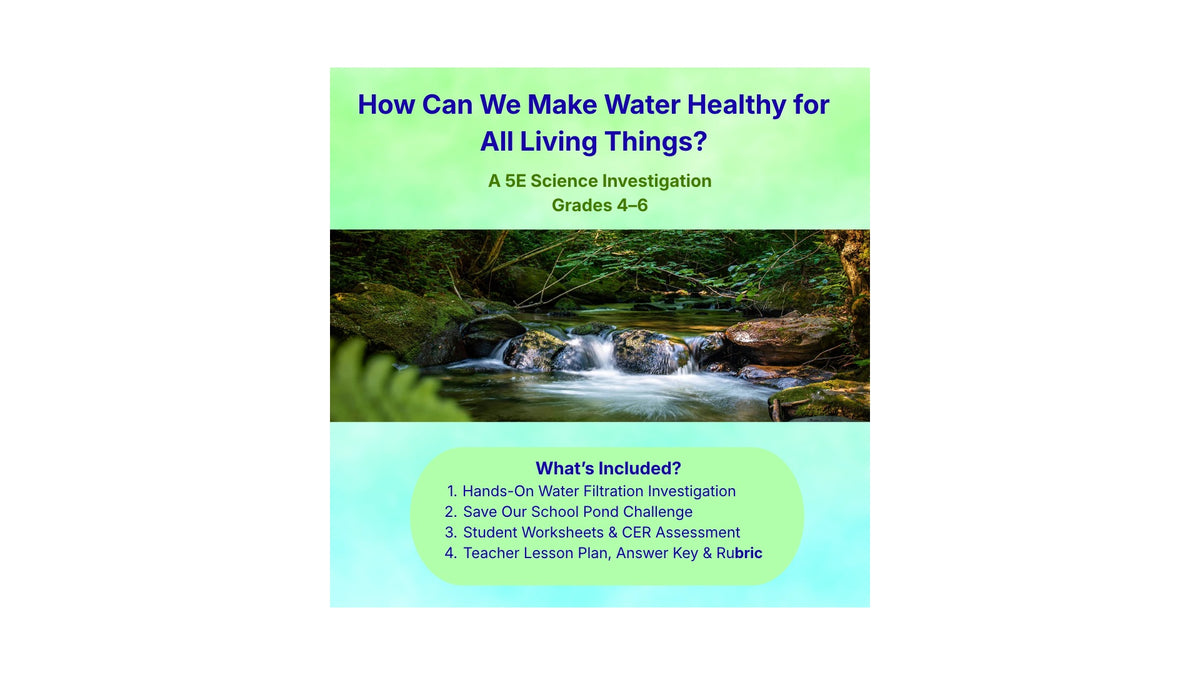
How Can We Make Water Healthy for All Living Things?
Hands-On Water Pollution & Filtration Science Lesson | Grades 4–6 | NGSS 5-ESS3-1
Can water look clean but still be unsafe? How can people protect the water that plants, animals, and humans depend on?
Get students thinking, investigating, and problem-solving with this engaging, hands-on environmental science lesson!
In How Can We Make Water Healthy for All Living Things?, students become young scientists and environmental problem-solvers as they explore water pollution, investigate filtration, and discover how communities can help protect Earth's water resources.
Students begin by examining photographs of water and discussing whether appearance alone can tell us if water is healthy. Next, they design, build, and test their own model water filters, recording observations and evaluating how well their designs remove visible particles.
Through a presentation about water pollution and cleanup efforts around the world, students learn why protecting water is essential for living things. They then apply their knowledge in the Save Our School Pond! engineering challenge, developing evidence-based solutions to a realistic environmental problem.
The lesson concludes with a Claim-Evidence-Reasoning (CER) assessment, exit ticket, and personal water-protection pledge.
What's Included?
-
Detailed 5E Teacher Lesson Plan — Step-by-step teaching instructions, discussion questions, suggested responses, timing, and differentiation.
-
Opening Phenomenon Presentation — Introduces the essential question and encourages observation, discussion, and scientific thinking.
-
Saving Our Water Presentation — Explores water pollution, water safety, cleanup efforts, and environmental responsibility.
-
Hands-On Water Filtration Investigation — Two student pages for predicting, designing, testing, observing, and improving a model filter.
-
Student Vocabulary & Understanding Worksheet — Reinforces filtration, pollutants, ecosystems, and conservation.
-
Save Our School Pond! Engineering Challenge — Students design solutions to protect a fictional school pond.
-
CER Assessment & Exit Ticket — Students use evidence to explain how people can protect and improve water quality.
-
Teacher Answer Key & 16-Point CER Rubric — Includes sample answers, assessment guidance, and common misconceptions.
Both presentations are provided in PowerPoint and PDF formats.
Students Will Learn To:
-
Explain how water pollution affects plants, animals, and ecosystems.
-
Design and test a model filter to remove visible particles from water.
-
Recognize that clear-looking water is not necessarily safe to drink.
-
Use observations and evidence to evaluate scientific solutions.
-
Identify ways individuals and communities can prevent or reduce water pollution.
-
Communicate scientific explanations using Claim-Evidence-Reasoning.
Standards & Grade Levels
Recommended Grades: 4–6
Primary NGSS Connection: 5-ESS3-1 — Obtain and combine information about ways individual communities use science ideas to protect Earth's resources and environment.
The lesson includes differentiated expectations and challenges for Grades 4, 5, and 6.
Estimated Time: 2–3 class periods
Why Teachers Will Love This Lesson
This resource combines hands-on science, environmental awareness, engineering design, critical thinking, and evidence-based writing in one organized teaching package.
Students do more than learn about pollution—they investigate a problem, test a solution, evaluate its limitations, and consider actions they can take to protect water resources.
Perfect for: Earth science units, environmental science lessons, water pollution studies, STEM investigations, engineering design activities, and Earth Day learning.
Important Safety Note: The classroom filtration investigation uses teacher-prepared model polluted water. Filtered water must never be tasted or consumed.
Help your students discover that protecting clean water is everyone's responsibility—and even small actions can make a difference!
Share